
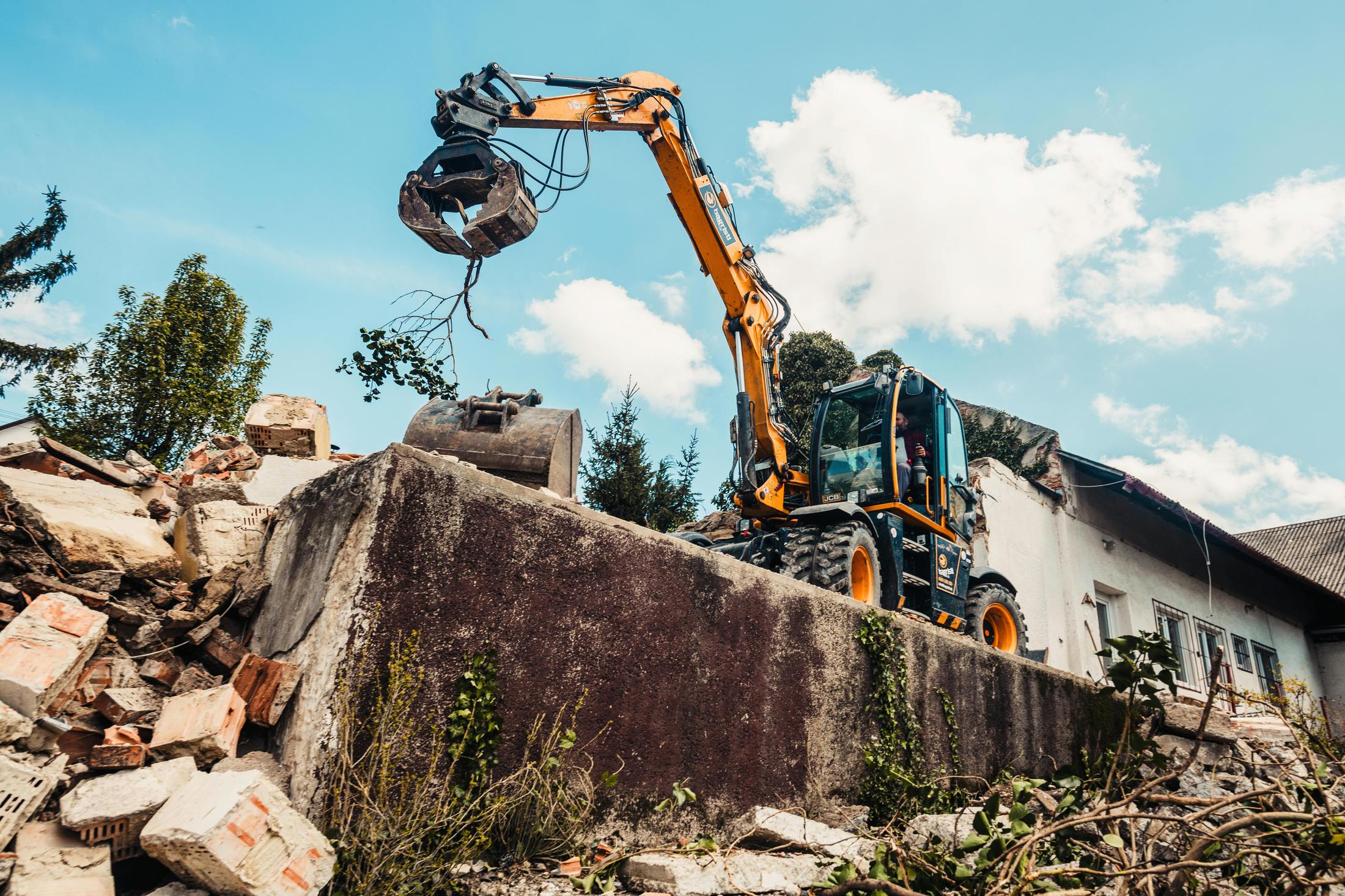
Residential demolition in Metro Detroit typically runs $8,000 to $25,000 for standard single-family homes under 3,000 square feet. Garages run $3,500 to $7,000. Larger homes, basement foundations, and hazmat abatement push the number higher. Real-world quotes vary widely because the cheap ones usually exclude costs that show up later as change orders.
Residential demolition pricing looks simple until you collect three quotes and they land at $12,000, $18,000, and $32,000 for the same house. The range isn't arbitrary. Each contractor is making different assumptions about scope, hazmat, disposal, and what counts as included. This guide walks through the actual math so you can compare quotes on the same terms and spot the ones that are going to surprise you on the back end.
Cost ranges by structure type
The fastest way to estimate demolition cost is by structure type. These ranges reflect complete scope: tear-down, debris hauling, foundation removal, and site grading to a clean, buildable lot. Hazmat abatement and permits are separate line items covered below.
These are 2026 Metro Detroit figures. Pricing in rural Michigan runs 15 to 25 percent lower due to lower disposal costs and easier site access. Dense urban Detroit sites, particularly those with narrow lots or shared walls, run 10 to 20 percent higher.
The 7 variables that drive cost
Two houses that look identical from the street can cost wildly different amounts to demolish. Here are the seven variables that actually determine the quote number, ranked by how much they move the price.
- Square footage and cubic volume. The single biggest driver. More material means more equipment time, more truckloads, more tipping fees. A 1,200 sqft ranch and a 2,400 sqft two-story aren't just double the cost because the two-story has more structural mass per footprint.
- Building materials. Wood frame and vinyl siding tear down fast and hauls cheap. Brick, masonry, and concrete block add significant weight and disposal cost. A full brick colonial can cost 30 to 40 percent more to demolish than a wood-frame equivalent.
- Foundation type. Slab-on-grade is simplest. Crawl space adds modest excavation. Full basement foundation doubles the site work: additional excavation, wall removal, and backfill material to grade the lot flat.
- Site access and staging. Wide flat lots with no adjacent structures let crews use larger equipment and work faster. Tight urban lots with neighboring houses, overhead power lines, or limited street access require smaller equipment, more careful sequencing, and often police-coordinated street closures.
- Hazmat presence. Any home built before 1980 likely contains asbestos in some form: floor tile, mastic, pipe insulation, roofing, siding. Lead paint is universal in pre-1978 homes. Testing costs $300 to $800. Abatement, when required, runs $8 to $25 per square foot of affected material.
- Utility disconnect complexity. Standard disconnects from DTE Energy and the local water authority are straightforward but take one to two weeks. Buried gas lines, shared utility connections with neighbors, or septic system decommissioning add time and coordination cost.
- Debris disposal and recycling. Landfill tipping fees in Southeast Michigan run $45 to $75 per ton as of early 2026. A typical single-family home generates 60 to 100 tons of debris. Concrete and metal can be diverted to recyclers at lower cost, which is why crews that actually sort materials often quote slightly lower on larger projects.
The cheapest demolition quote is usually the one that assumed you don't have asbestos, a basement foundation, or neighbors close enough to care.
Metro Detroit-specific factors
Pricing in Metro Detroit has a few local wrinkles that don't show up in national cost calculators.
Detroit vs. suburban pricing
Demolition within Detroit city limits typically runs 10 to 15 percent higher than equivalent work in Oakland or Macomb counties. The gap comes from three factors: tighter urban lots that require smaller equipment, stricter BSEED permit requirements that extend timelines, and higher dump fees at the closest transfer stations.
Historic district requirements
Detroit has multiple locally designated historic districts including Boston-Edison, Indian Village, and Corktown. Demolition within these districts requires Historic District Commission review in addition to standard permits. This adds four to eight weeks to the timeline and can trigger documentation requirements like photographic surveys and salvage plans.
Detroit Land Bank Authority projects
Demolitions funded through the Detroit Land Bank Authority follow a separate bidding and contractor-approval process. Private owners working adjacent to DLBA demolitions should confirm scope boundaries in writing to avoid scope overlap or disputes over shared utility lines.
Tipping fee variation by county
Wayne County has more landfill and transfer station capacity than Oakland or Macomb, which keeps haul distances shorter for most Detroit-area jobs. Northern Oakland and northern Macomb projects sometimes incur $500 to $1,500 in additional hauling cost due to longer drives to the nearest licensed construction and demolition debris facility.
Permits and compliance costs
Permits and compliance fees are separate from demolition scope and vary by municipality. For residential demolition in Metro Detroit, budget the following:
- Wrecking permit. Detroit through BSEED runs $200 to $500 for residential. Suburban municipalities generally run $100 to $300.
- EGLE asbestos notification. Required for any structure over 150 square feet being demolished. Filing fee is minimal, typically under $100, but the 10-day notification window must be observed before work begins.
- Utility disconnect fees. DTE Energy charges for meter removal and service termination, typically $200 to $500 combined for gas and electric. Water service termination is usually included in the permit fee by municipality.
- Street closure permit. Required when equipment or debris trucks need to occupy the roadway. Detroit runs $150 to $400 per day. Suburban municipalities vary widely.
- Erosion control bond. Required in most Oakland County municipalities and some Wayne County ones. Typically $500 to $1,500, refundable after final inspection confirms the site was properly stabilized.
For a detailed walkthrough of the Detroit permit process specifically, see the demolition permits in Detroit guide.
Hidden costs to watch for
These are the line items that show up on the final invoice but were not in the original quote. Ask about each one explicitly before signing.
Asbestos testing and abatement. Tree protection or removal. Erosion control bonds. Street closure permits. Chimney and fireplace demolition. Attached garage slab removal. Pool removal if present. Sidewalk or driveway replacement after access damage.
Asbestos testing and abatement
The biggest variable. Testing is $300 to $800. If asbestos-containing materials are found, full abatement by a licensed firm runs $8 to $25 per square foot of affected material. For a 1,500 sqft home with typical pre-1980 construction, total hazmat costs land between $2,500 and $12,000 depending on what's present.
Foundation removal
Some quotes demolish the house but leave the foundation intact. If you need a fully cleared lot for rebuild or sale, confirm foundation removal is included. Adding it after the fact runs $3,000 to $8,000.
Tree protection and removal
Many Metro Detroit municipalities have tree protection ordinances requiring documented protection of mature trees near demolition work. Removing protected trees typically requires a separate permit and replacement fee. Budget $500 to $2,000 in protection costs or $800 to $3,000 per tree for removal with permits.
Shared structural elements
In older Detroit neighborhoods with adjacent houses, shared walls, shared chimneys, and shared foundation walls create significant demolition complexity. Crews must brace the neighbor's structure, pour new retaining walls if needed, and often negotiate timing with the adjacent owner. Budget $2,000 to $8,000 extra when this applies.
How to get an accurate quote
The difference between a quote that holds and a quote that balloons comes down to what information you provide and what questions you ask. Here's what a good quote process looks like.
What to provide the contractor
- Year built and square footage. Drives the hazmat assessment and equipment selection.
- Foundation type. Slab, crawl, basement. Know before the site visit.
- Attached structures. Garages, additions, decks, pools, fences, sheds.
- Site access description. Lot width, distance from street to structure, adjacent neighbors, overhead obstacles.
- End condition desired. Clean and graded for rebuild, rough clear, or raw pile.
- Timeline constraints. Permit deadlines, rebuild start dates, season preferences.
What a good quote includes
A complete demolition quote should itemize: tear-down scope, foundation handling, hazmat allowance, permit fees, utility disconnect coordination, haul-away, and final grade condition. Vague one-line quotes that just say "demolish house $X" are the ones that add up later.
Red flags in cheap quotes
Quotes that come in 30 percent below the others usually exclude: hazmat testing and abatement, foundation removal, permit fees, utility disconnect coordination, erosion control, and final grading. Ask for each of these in writing. If they're excluded, add the numbers back in and re-compare.
Timeline from quote to clean lot
Metro Detroit demolition projects typically run two to six weeks from signed contract to final grade, depending on municipality, hazmat scope, and utility coordination.
- Week 1: Permit application and utility requests. Contractor files for wrecking permit, notifies EGLE if required, requests utility disconnects from DTE and water authority.
- Weeks 2 to 3: Disconnect clearances and hazmat work. Utility meters removed, disconnect confirmations received in writing. Asbestos abatement completed if required. Final permit approval obtained.
- Days 4 to 7 (or 1 to 3 days of active work): Structural demolition. Tear-down begins. Most single-family homes fall in one to two days of machine time. Interior-only demolition takes longer due to hand work.
- Days 8 to 12: Debris haul and foundation removal. Sorted debris trucked to landfill, recycling, or transfer station. Foundation excavated if in scope.
- Days 13 to 14: Grading and final cleanup. Site graded to approved plan. Erosion control measures installed. Final inspection requested.
Add four to eight weeks for historic district projects. Add two to three weeks for projects requiring extensive hazmat abatement. Weather does impact timing in January through March when frozen ground can delay excavation work.