
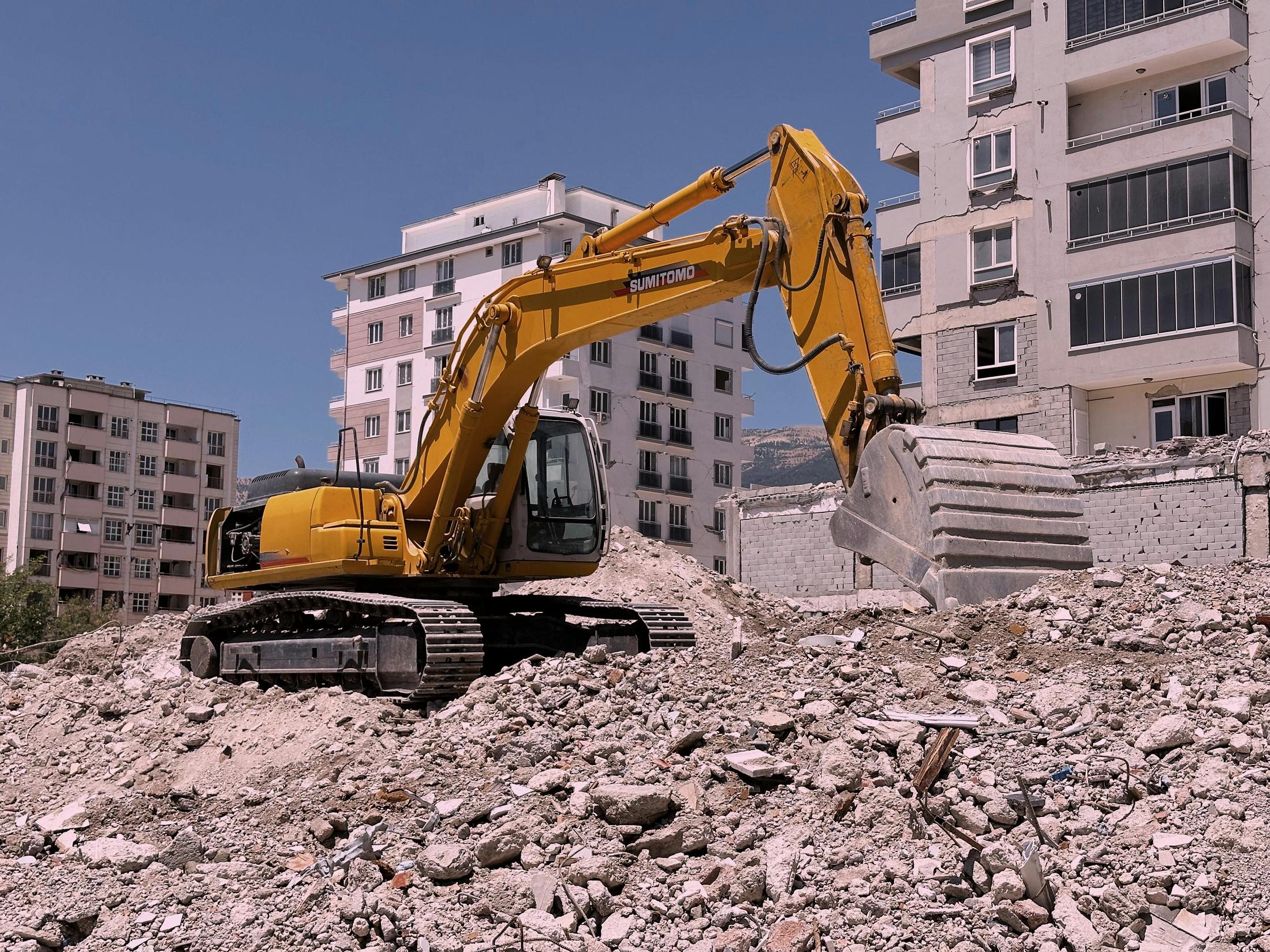
Commercial demolition in Metro Detroit typically runs $5 to $15 per square foot depending on structure type, building height, and hazmat complexity. A 10,000 sqft retail building usually falls between $50,000 and $120,000. A 50,000 sqft warehouse runs $250,000 to $600,000. Commercial has more variables than residential and the lowest bid often excludes Phase I environmental assessments and asbestos abatement that become required before work can start.
- Cost per square foot by building type
- Example project totals
- The variables that drive commercial pricing
- Metro Detroit commercial market factors
- Environmental assessments and hazmat
- Hidden costs in commercial scope
- How to structure a quote for accurate comparison
- Timeline from contract to cleared site
Commercial demolition quotes vary more than residential for one main reason: commercial buildings are more different from each other. A 8,000 sqft single-story retail strip and a 8,000 sqft three-story office building cost wildly different amounts to demolish because everything about them is different. The structural system, the mechanical rooms, the roof assemblies, the underground utilities, and what is in the walls. This guide walks through the actual commercial pricing math so developers, owners, and general contractors can compare bids on the same terms.
Cost per square foot by building type
Commercial demolition is almost always quoted on a dollars-per-square-foot basis because that is how contractors estimate scope. These ranges reflect complete tear-down including debris hauling, foundation removal, and site grading to a buildable condition. Environmental assessments, asbestos abatement, and underground storage tank removal are separate.
The higher end of each range applies to buildings in dense urban areas, buildings with significant asbestos, buildings requiring dust containment for operating neighbors, and projects with tight access or limited staging space.
Example project totals
Per-square-foot numbers are useful for early estimates, but most owners think in total project budgets. Here are typical 2026 Metro Detroit totals for common project sizes.
These totals assume standard scope. Add environmental and abatement line items separately. Budget another 8 to 20 percent of structural demolition cost for hazmat work on pre-1990 commercial buildings.
The variables that drive commercial pricing
Ten factors determine whether a commercial quote lands at the low or high end of the range for that building type. Ranked roughly by how much each moves the number.
- Square footage and cubic volume. The largest single driver. Larger buildings require more equipment time, more truckloads, more labor days, and more tipping fees at landfill.
- Number of stories. Multi-story demolition requires top-down sequential approach, additional engineering, and often larger equipment staged longer. A 20,000 sqft three-story building costs more than a 20,000 sqft single-story of equivalent materials.
- Structural system. Wood frame is fastest and cheapest. Steel frame requires cutting and disassembly. Concrete frame and cast-in-place construction require crushing equipment and generates massive recyclable debris volumes.
- Mechanical and electrical complexity. Commercial buildings have significant MEP systems: roof-top units, elevators, fire suppression, emergency generators, transformer vaults. Removal and disposal of these systems adds meaningful time.
- Underground elements. Basements, sub-basements, tunnels, sumps, elevator pits, and underground utility vaults all extend excavation scope and cost. Full basement demolition can double the underground work.
- Hazmat presence. Commercial buildings built before 1990 almost always contain asbestos in floor tile, mastic, pipe insulation, fireproofing, roofing, or drywall texture. Pre-1978 buildings typically have lead paint. Older electrical equipment may contain PCBs. Commercial hazmat scope is often five to ten times residential.
- Site access and staging. Urban sites with limited street access, adjacent occupied buildings, or overhead power lines require smaller equipment, more careful sequencing, and often police-coordinated street closures for debris hauling.
- Adjacent building protection. Shared walls with occupied buildings require vibration monitoring, temporary bracing, air quality monitoring, and sometimes post-demolition foundation repairs on the adjacent structure.
- Operating-neighbor constraints. Demolition adjacent to operating businesses often requires after-hours or weekend work for the noisiest phases, dust containment, and coordinated access schedules. Typically adds 15 to 30 percent to baseline cost.
- Debris disposal and recycling logistics. Commercial demolitions often generate significant salvageable material including structural steel, copper, aluminum, and HVAC equipment. Crews that sort and divert recyclables can offset disposal costs but require more on-site handling time.
Commercial demolition quotes should be compared on itemized scope, not on total price. The contractor who includes environmental allowance and asbestos abatement will always look more expensive than the one who omits them.
Metro Detroit commercial market factors
Commercial pricing in Metro Detroit has regional variation driven by specific market conditions.
Detroit CBD vs. suburban pricing
Commercial demolition in the Detroit central business district runs 15 to 25 percent higher than suburban equivalent work. The premium comes from staging constraints, Detroit wage rates, BSEED permit complexity, and limited nearby landfill capacity. Suburban Wayne, Oakland, and Macomb County projects have more flexible access and often lower disposal costs.
Brownfield sites and remediation history
Metro Detroit has an extensive industrial legacy. Many commercial sites qualify as brownfields and may have existing contamination from prior industrial use. Michigan's Baseline Environmental Assessment, commonly called BEA, provides liability protection for new owners but requires formal documentation filed with EGLE. Brownfield sites often qualify for redevelopment tax incentives through the Michigan Economic Development Corporation, commonly called MEDC.
Detroit Land Bank Authority commercial inventory
The Detroit Land Bank Authority, commonly called DLBA, holds a significant inventory of commercial properties available for development. Projects involving DLBA properties follow a structured proposal process with required demolition scope and timeline commitments. DLBA-adjacent projects should confirm boundaries and utility lines before scoping.
Industrial corridor projects
Metro Detroit's industrial corridors including I-94 in Detroit, Mound Road in Warren, and the Hamtramck industrial district see frequent large-scale demolitions. These projects often involve coordinated demolition of multiple buildings, specialized heavy equipment, and environmental remediation of prior industrial uses.
Historic commercial districts
Downtown Detroit, Corktown, and several suburban downtowns have historic district overlays that affect commercial demolition. Historic District Commission review adds four to eight weeks to permit timelines and may require documentation surveys or partial salvage plans before demolition can proceed.
Environmental assessments and hazmat
The environmental scope is what separates straightforward commercial demolitions from complex ones. Plan for the following line items as standard for any pre-1990 commercial structure.
Phase I Environmental Site Assessment
A Phase I ESA reviews historical property use, adjacent site use, regulatory database records, and conducts a visual site inspection. Phase I ESAs cost $2,500 to $5,000 and are typically required by commercial lenders before any transaction or financing. Phase I identifies recognized environmental conditions that trigger further investigation.
Phase II Environmental Site Assessment
If Phase I identifies concerns, a Phase II ESA conducts soil borings, groundwater monitoring well installation, and laboratory analysis. Phase II ESAs cost $5,000 to $25,000 depending on site size and sample count. Phase II results determine remediation requirements and may trigger reporting obligations to EGLE.
Asbestos abatement scope
Commercial asbestos abatement is significantly larger in scope than residential. Pre-1990 commercial buildings typically contain asbestos in spray-applied fireproofing, floor tile and mastic across large areas, pipe insulation in mechanical rooms, roofing membrane systems, and drywall joint compound. Licensed abatement for a typical 20,000 sqft commercial building runs $40,000 to $150,000 depending on material extent and type.
Other regulated materials
Commercial buildings also contain regulated materials beyond asbestos. PCBs in older electrical transformers and fluorescent light ballasts. Mercury in old thermostats and switches. Lead paint in pre-1978 industrial facilities. Each requires specific disposal protocols and adds cost proportional to extent.
Hidden costs in commercial scope
These are the line items that show up on final commercial demolition invoices but often get omitted from low bids. Ask about each explicitly during the quoting phase.
Phase I and Phase II environmental assessments. Asbestos testing and abatement. PCB equipment removal. Underground storage tank removal and soil testing. Air monitoring during abatement. Brownfield reporting. Traffic control for debris hauling. Overhead utility relocation. Roof and canopy structure demolition. Performance bond fees.
Underground storage tank removal
Former gas stations, industrial facilities, and older commercial buildings with backup generators may have underground storage tanks. Tank removal requires licensed contractors, EGLE notification, soil sampling, and potential remediation. Budget $5,000 to $15,000 per tank plus remediation cost if contamination is found.
Performance and payment bonds
Many commercial demolition projects require performance bonds for 100 percent of contract value and separate payment bonds for labor and materials. Bond premiums typically run 1 to 3 percent of contract value and are paid by the contractor but priced into the quote.
Traffic control and street closures
Downtown and urban commercial demolitions often require multi-day street closures for debris hauling operations. Traffic control personnel, barricades, and municipal permit fees for street closures typically add $5,000 to $25,000 to urban project budgets.
How to structure a quote for accurate comparison
Commercial demolition bids are hard to compare because contractors assume different scopes when unclear. Here is how to structure your Request for Proposal to get bids that can actually be compared apples to apples.
What to provide
- Complete building plans. Floor plans, structural drawings, and MEP drawings if available.
- Year built and major renovations. Drives hazmat assessment and equipment selection.
- Previous uses history. Particularly for industrial, automotive, or chemical-related prior uses.
- Phase I ESA findings. If already completed. If not, note that Phase I is needed.
- Site survey with utilities. Showing overhead and underground utilities, adjacent properties, and easements.
- Timeline and scheduling constraints. Operating neighbors, permit deadlines, construction start dates.
- End condition required. Cleared to grade, cleared with specific foundation retention, or raw pile.
What a commercial quote should itemize
Require each bid to itemize structural demolition cost, foundation and underground element removal, hazmat abatement allowance or stated exclusion, debris hauling and disposal, permits and compliance fees, utility disconnect coordination, erosion control and site protection, mobilization and demobilization, and general conditions. Vague bids with a single total are the ones that become problems later through change orders.
Red flags in low bids
Commercial bids significantly below the others usually exclude environmental assessments, asbestos abatement, underground element removal, permit fees, or performance bonds. They may also assume smaller equipment than the job actually requires, which extends timeline and adds labor cost as change orders.
Timeline from contract to cleared site
Commercial demolition projects in Metro Detroit typically run two to six months from contract signing to cleared site, with larger or more complex projects extending further.
- Weeks 1 to 4: Pre-demolition assessments. Phase I ESA if not already complete. Asbestos testing. Building survey. Permit application preparation.
- Weeks 4 to 10: Abatement and permits. Asbestos abatement if required, conducted under air monitoring and EGLE oversight. Final permit approval. Utility disconnect coordination and confirmations.
- Weeks 8 to 12: Equipment mobilization and site preparation. Equipment delivery, site fencing, erosion control installation, traffic control setup if urban.
- Weeks 10 to 16: Structural demolition. Active teardown. Duration varies from one week for small retail to six weeks for large multi-story buildings.
- Weeks 14 to 20: Debris processing and foundation removal. Sorting recyclables, hauling to disposal, foundation excavation if in scope.
- Weeks 18 to 24: Site grading and final cleanup. Final grade to specification, erosion control removal, site inspection and sign-off.
Projects with brownfield remediation, historic district review, or significant underground element removal can extend these timelines by four to twelve weeks. Complex Phase II ESA findings with contamination remediation may add three to six months before demolition can proceed.